

 Get Solution Of Your Problem Anytime From Anywhere










Finding the best astrologer in South India is rarely a matter of browsing sponsored directory listings, celebrity endorsements, or paid media listicles. In classical Indian epistemology, the merit of an astrologer (Daivajna) is determined by adherence to a recognized lineage (Parampara), computational and interpretive precision, and an unyielding ethical boundary that preserves the client’s moral agency. South India—spanning Kerala, Tamil Nadu, Karnataka, and Andhra Pradesh—remains the custodian of several specialized branches of Jyotish (Vedic astrology), ranging from the horary procedures of Prashna Marga to the stellar sub-lord divisions of Krishnamurti Padhdhati (KP).
To an educated seeker, navigating this territory requires recognizing what classical Jyotish fundamentally claims to be. Traditionally classified as a Vedanga—the auxiliary discipline functioning as the “eye of the Veda” (Jyotisham netram ucyate)—the system was formulated as a diagnostic map of cyclical time (Kala) and karmic momentum. It was never intended as a transactional mechanism to override destiny, manufacture wealth, or subjugate another person’s will. The most accomplished astrologers in South India approach the craft with scholarly humility: they do not sell guaranteed outcomes or peddle fear, but instead interpret structural patterns to cultivate discernment (Viveka) and informed action (Purushartha).
The Four Core Astrological Traditions of South India
South Indian astrology is not a uniform practice. While North Indian traditions lean heavily on standard Parashari models rendered in diamond-format charts, the southern states have developed and refined distinct methodological schools. Determining who the “best” practitioner is for a given situation depends entirely on the tradition best suited to the nature of your inquiry
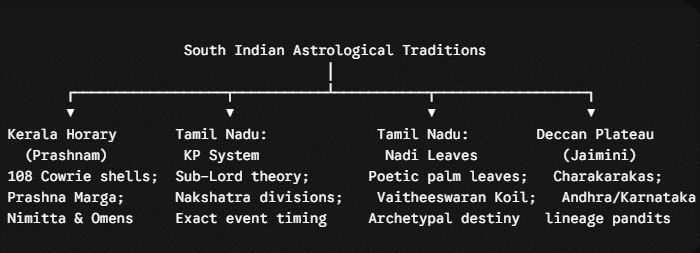
- Kerala Horary Astrology: The Prashna Marga Lineage
Kerala holds a distinct place in Indian divination due to its preservation of Prashna (horary astrology). While natal astrology maps the moment of birth, horary astrology maps the cosmic geometry of the moment a pressing question is formally posed.
Classical Textual Authority: The primary authority is Prashna Marga, a monumental 1649 CE Sanskrit treatise authored by Panakkattu Namboodiri of Edakkad. It synthesizes natal analysis, planetary hours, omens, and mathematical subdivisions into an exhaustive diagnostic system.
Ashtamangala Prashnam: Used primarily for resolving ancestral inheritances, temple renovations, and persistent structural crises within families, this technique employs 108 cowrie shells (kavadis). The shells are systematically counted and divided using specific modular arithmetic to isolate the root cause of an affliction (Dosha).
The Science of Synchronization (Nimitta): A master of the Kerala school closely observes Nimitta Shastra (synchronistic omens). The direction the querent faces, the breath pattern (Svara) of the practitioner, and external events occurring at the exact second the query is presented are factored into the reading alongside the planetary chart.
- Tamil Nadu’s Modern Mathematical Reform: The KP System
Developed in the mid-20th century by K.S. Krishnamurti (1908–1972), Krishnamurti Padhdhati (KP System) arose out of dissatisfaction with the ambiguities often found in traditional predictive rules.
Sub-Lord Theory: The foundational premise of KP is that a planet does not merely deliver results based on its sign placement, but primarily through the ruler of the lunar mansion (Nakshatra) it occupies, and more specifically through the “Sub-Lord.” KP divides each of the 27 Nakshatras into nine unequal subdivisions based on the proportions of the Vimshottari Dasha system.
Placidus House Division: Unlike whole-sign house systems common in ancient texts, KP utilizes the semi-arc Placidus system to define exact house cusps, bringing mathematical precision to event timing (e.g., employment transitions, property registration, litigation resolutions).
Ruling Planets (RP): KP practitioners evaluate the “Ruling Planets” calculated for the exact time and place of judgment to test whether an event promised by the natal chart has matured enough to materialize.
- Tamil Nadi Astrology: Cultural Artifact vs. Modern Commercial Reality
Nadi astrology posits that ancient Siddhars (revered spiritual figures such as Agastya, Bogar, and Kakabhujandar) recorded the karmic arcs of specific souls on palmyra leaves (olai chuvadi), preserved across centuries in repositories like Vaitheeswaran Koil.
The Intended Mechanism: The seeker provides a thumb impression (traditionally right for men, left for women), which is categorized into one of dozens of structural loop patterns. The reader uses index leaves to retrieve candidate bundles (kattus), chanting metered Tamil poetry to locate matching parental names, profession, and previous milestones.
Scholarly Perspective: In classical texts like the Deva Keralam (Chandrakala Nadi), Nadi techniques represent sophisticated combinations of subtle divisional charts (Nadi Amshas, dividing a sign into 150 parts) rather than simple pre-written scripts.
The Commercial Trap: Seekers must approach the modern Nadi industry with acute skepticism. Commercial operations frequently employ cold-reading psychological tactics and leading questions to narrow down identities, using the resulting performance to demand high fees for manufactured temple remedies (Pariharams).
- Deccan Jaimini and Panchanga Rigor (Karnataka and Andhra Pradesh)
In the scholarly circles of coastal Karnataka, Mysore, and Andhra Pradesh, Jyotish analysis often highlights the intricate aphorisms of the Jaimini Upadesha Sutras.
Sign-Based Periods (Rashi Dashas): Unlike Parashari astrology, which measures time using planetary periods, the Jaimini school measures time primarily through signs, using techniques like Chara Dasha and Sthira Dasha.
Variable Indicators (Charakarakas): Planets are assigned functional roles based on their descending order of degrees within any sign—from the highest degree (Atmakaraka, significator of the soul) to the second highest (Amatyakaraka, significator of career and intellect), providing an alternative lens on character and status.
The Vakya vs. Drik Divide: A central consideration across South India is the choice of ephemeris. Traditional temple almanacs often rely on Vakya Panchangam, which uses ancient, fixed mnemonic verses. Modern predictive practitioners favor Drik Ganitha (such as the Thirukanitha system), which aligns with direct astronomical observation. Evaluating an astrologer’s awareness of this mathematical distinction is an immediate indicator of technical literacy.
Evaluating the Best Astrologer in South India: Standards vs. Scams
Because astrology in India operates without standardized licensing, high search visibility and promotional visibility are often decoupled from competence. Genuine practitioners can be distinguished from commercial enterprises across several clear operational axes:
| Evaluation Metric | Authentic South Indian Practitioner | Commercial Operator / Aggregator |
| View of Destiny | Treats karma as a mixture of fixed (Dridha) and malleable (Adridha) tendencies; respects free will. | Asserts absolute fatalism or promises total control over destiny for a price. |
| Prescription of Remedies | Recommends personal introspection, ethical lifestyle adjustments, or simple mantra recitations. | Insists on exclusive, high-cost proxy rituals, locked talismans, or overpriced gemstones. |
| Stance on Coercion | Rejects practices that violate another individual’s autonomy (e.g., love control, subduing rivals). | Sells “Guaranteed Vashikaran,” breakup rituals, or overnight enemy suppression. |
| Analytical Rigor | Verifies birth time via past events; accounts for geographical coordinates and ephemeris corrections. | Offers vague, generic predictions based merely on raw sun signs or rough birth dates. |
| Delivery of Predictions | Frames insights in terms of probabilities, psychological tendencies, and cyclical timing. | Promises immediate, absolute certainties within arbitrary windows (e.g., “Results in 24 hours”). |
Karma Theory and the Limits of Astrological Remedies (Upayas)
A major source of confusion among seekers looking for an astrologer in South India involves the function of remedies (Upayas). Popular culture often treats them as transactional exchanges intended to alter fate. Classical philosophy paints a fundamentally different picture.
Traditional texts divide the consequences of past action into three clear categories:
Dridha Karma (Fixed): Actions whose consequences are deeply etched. These manifestations must be experienced directly; classical thought maintains that no ritual, gemstone, or chant can annul them. Their remedy is psychological endurance, ethical fortitude, and philosophical acceptance.
Dridha-Adridha Karma (Semi-Fixed): Influences that can be meaningfully redirected or mitigated through sustained personal effort, moral reorientation, and spiritual disciplines.
Adridha Karma (Flexible): Tendencies that are fluid and easily reshaped by present, conscious decisions (Kriyamana karma).
A qualified astrologer first diagnoses which tier of karma is at play. When authentic treatises like the Brihat Parashara Hora Shastra outline remedial measures, they frame them as internal therapies designed to harmonize specific psychological and energetic patterns—not as bribes to planetary deities. An astrologer claiming they can wipe away any structural challenge through a paid ceremony is offering promises unsupported by classical doctrine.
The Ethics of Tantra and the “Vashikaran” Deception
Inquiries regarding South Indian practitioners are frequently clouded by advertisements promising Vashikaran—the alleged occult subjugation of another person’s emotions or will. The commercial industry targeting these searches preys directly on heartbreak, family discord, and acute personal loss.
Classical Tantra vs. Domestic Manipulation
In orthodox Shakta and Shaiva Tantric traditions, the Shatkarmas (six categories of internal and external actions, of which Vashya or attraction is one) were documented as rigorous psychological and energetic sadhanas. They were intended exclusively for advanced aspirants working toward the mastery of internal senses (Indriyas) or, in rare historical contexts, the pacification of severe social strife under direct spiritual oversight.
Using esoteric rites to force an estranged partner into submission or override someone’s romantic consent is classified in traditional ethics as an act of harm (Abhichara). Within the framework of karmic causation, such actions are believed to incur severe personal consequences for both the practitioner and the client.
The Anatomy of the Commercial Scam
Practitioners advertising “Instant Vashikaran Solutions” in South India almost universally run extractive financial operations. The process typically follows a predictable pattern:
Initial Validation: The client is told their situation is uniquely solvable, but requires an urgent preliminary ritual to “bind” the energies.
Manufactured Crises: Days later, the client is informed of unexpected negative forces or ancestral curses that require larger sums to neutralize.
Coercion and Threats: If the client hesitates to send additional funds, the operator threatens that halting the ritual midway will cause immediate harm to the client or their family.
An ethical South Indian Jyotishi will categorically refuse requests aimed at manipulating another person’s autonomy. They view astrology as a guide for self-reflection and personal accountability, not an engine for interpersonal control.
Preparing for an Authentic Consultation
To extract genuine value from an astrological consultation in South India, seekers should approach the interaction with clear analytical boundaries and structured preparation.
- Ensure Chronological Accuracy
South Indian charts utilize a fixed-sign, square layout: Aries is permanently fixed in the second box of the top row, and subsequent signs proceed clockwise. The Ascendant (Lagna) shifts through these signs based on the exact time of day.
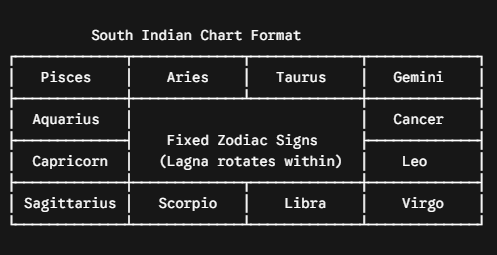
Because divisional charts (Vargas) change signs every few minutes, an accurate birth record is essential:
Secure an exact birth time cross-referenced against institutional birth records.
If your birth time is uncertain within a 15-to-30-minute window, request a preliminary Birth Time Rectification (Tattva Shodhana or KP ruling planet verification) before seeking life forecasts.
- Formulate Specific, Actionable Inquiries
Open-ended prompts like “Tell me what will happen in my life” encourage generic statements and subjective validation (the Barnum effect). Instead, construct focused questions tied to specific planetary cycles:
“I am evaluating a career transition from corporate management to independent enterprise. What do my current Dasha and transits indicate regarding financial stability over the next two years?”
“Are there structural patterns in my chart indicating recurrent communication breakdowns in personal partnerships, and what blind spots should I be conscious of?”
- Maintain Discernment
View the astrologer as a technical interpreter of a symbolic system, not an infallible authority. If a practitioner attempts to induce panic, demands large sums to avert imminent catastrophe, or discourages critical thinking, end the consultation immediately.
The best astrologers in South India maintain the classic posture of the Daivajna: scholars who study the movements of time to provide a sober, steadying perspective on life’s inevitable cycles. Their aim is not to make you dependent on their foresight, but to return you to your own life with greater equanimity, clarity, and personal responsibility.